
Trace Morgan County Former Owners Through Time
Every former-owner search in Morgan County works the same way. Take the newest conveyance you know about and step back one deed at a time. Doxpop's online index reaches recorded documents from January 1990 forward. Older ownership sits in Recorder deed books and Indiana State Library microfilm. Keep the legal description beside every name you collect. Subdivision, lot, acreage, and book references separate people who share a name. They also keep the parcel tied together. That matters when a street address changes across decades of deed records.
| Source | Years It Covers | Where Held | What It Shows |
|---|---|---|---|
| Doxpop recorded-document index | January 1990 to present | Morgan County Recorder online partner | Grantor, grantee, recording date and document references |
| Deed books and indexes | Beginning in 1822 | Recorder and State Library microfilm | Earlier transfers and full legal descriptions |
| Historic owner and plat maps | 1860, 1875, 1897, 1909, 1916 and 1923 | Indiana State Library | Owner or tract clues tied to period geography |
| Assessor books and tax duplicates | Selected historic runs | State Library finding aid | Assessment names by year, useful as supporting evidence |
A transfer after 1989 starts online. Earlier owners require the Morgan County microfilm finding aid before any visit or reel request. Tax rolls and maps can suggest a name, but only the deed sequence proves the chain.
Read the Morgan County Deed Chain Backward
Think of each transfer as a bridge across time. First find the deed that gave the current owner the land. Read its grantor, then hunt that same person as an earlier grantee. Repeat the process, always matching the legal description. A name match alone is dangerous. Without a matching lot, section, acreage, or recorded reference, the trail can wander into an unrelated family's property records.
- Use the assessor or tax result to identify the current deeded owner and parcel.
- Search that owner as grantee in the recorded-document index and identify the acquisition deed.
- Record the grantor, deed type, recording date, instrument or book/page, and legal description.
- Search the grantor as a grantee in an earlier date range, then repeat the comparison.
- At January 1990, move the same names and legal-description clues into the paper or microfilm reverse index.
- Grantor and grantee
- The conveying party and receiving party named in an instrument.
- Chain of title
- The ordered sequence of transfers affecting the same land.
- Reverse index
- An index organized by grantee, useful for finding how a former owner acquired the property.
- Warranty and quitclaim deeds
- Different conveyance forms; neither label alone proves that every title issue was resolved.
Morgan's January 1990 Online Divide
The Doxpop county coverage list shows Morgan's index and scanned images beginning in January 1990. Doxpop describes index updates as near real time. Image updates arrive daily. The service itself cautions that its web data is not the official record. For any critical reference, confirm with the Morgan County Recorder, Anna Voyles. The office is at 180 S Main Street, Suite 125, Martinsville. The office posts weekday hours of 8:00 a.m. to 4:00 p.m. Phone (765) 342-1077. Do not mistake the cutoff for the start of Morgan County ownership history. It only marks a change of medium. The name and legal-description trail continues into filmed indexes and bound deed volumes. Note: Confirm counter access before traveling. August 2026 closure and relocation notices may affect normal arrangements.
Pre-1990 Morgan Deed Books Preserve the Trail
Morgan County deed volumes open in 1822, the year after the county was organized. The State Library finding aid tracks grantor and grantee indexes through 1903. That depth of catalog turns a vague historic-house question into a concrete reel-and-volume request. Before opening any deed book, write down the exact index entry. Note the party, volume, page, date, and tract clue. The Indiana State Library county guide also lists land tract material. It covers WPA indexes, maps, and local repositories too. The Recorder stays the official custodian of these property records. The library's catalog and microfilm simply make remote planning easier.
Legal Descriptions Keep Previous Owners on One Parcel
Street names are modern conveniences, not the historic key. A Morgan County description may rely on a subdivision and lot. It may instead rely on acreage, or on township, range, and section. One Goat Hollow Estates deed identifies Lot 6 and 7.57 acres. Its township, range, and section fields sit blank. That contrast carries a lesson. You should record every identifier a document actually supplies and never fill a blank by guesswork. A plat, deed description, APN, and map number may describe the same land in different systems. Two candidate deeds may name the same person. Compare the land language and adjoining tracts before accepting either into the former-owner chain.
Probate and Court Transfers Interrupt a Simple Sale Sequence
Not every Morgan County former owner acquired land through a simple purchase. A personal representative's deed, sheriff's deed, partition, quiet-title order, or estate proceeding can explain why a seller-to-buyer link suddenly vanishes. Search recorded instruments first. The Indiana MyCase portal then offers a public docket clue, and the complete file can be requested from the Morgan County Clerk. The Morgan County Public Library's probate index adds a surname route and a mail research procedure. Probate evidence may explain someone's authority to convey. But the later recorded deed shows how that estate event entered the property-record chain.
Historic Maps Offer a Former-Owner Name Clue
The State Library's Morgan map collection spans editions from 1860 through 1923. An owner label near the right road can supply the surname an old deed index demands. So can one near a creek or section. City directories add address evidence for Martinsville and Mooresville tied to specific years. Neither source establishes title. Each simply bridges the gap between a modern parcel and an older deed-book entry. The official Morgan County maps collection presents the historic-map access route:
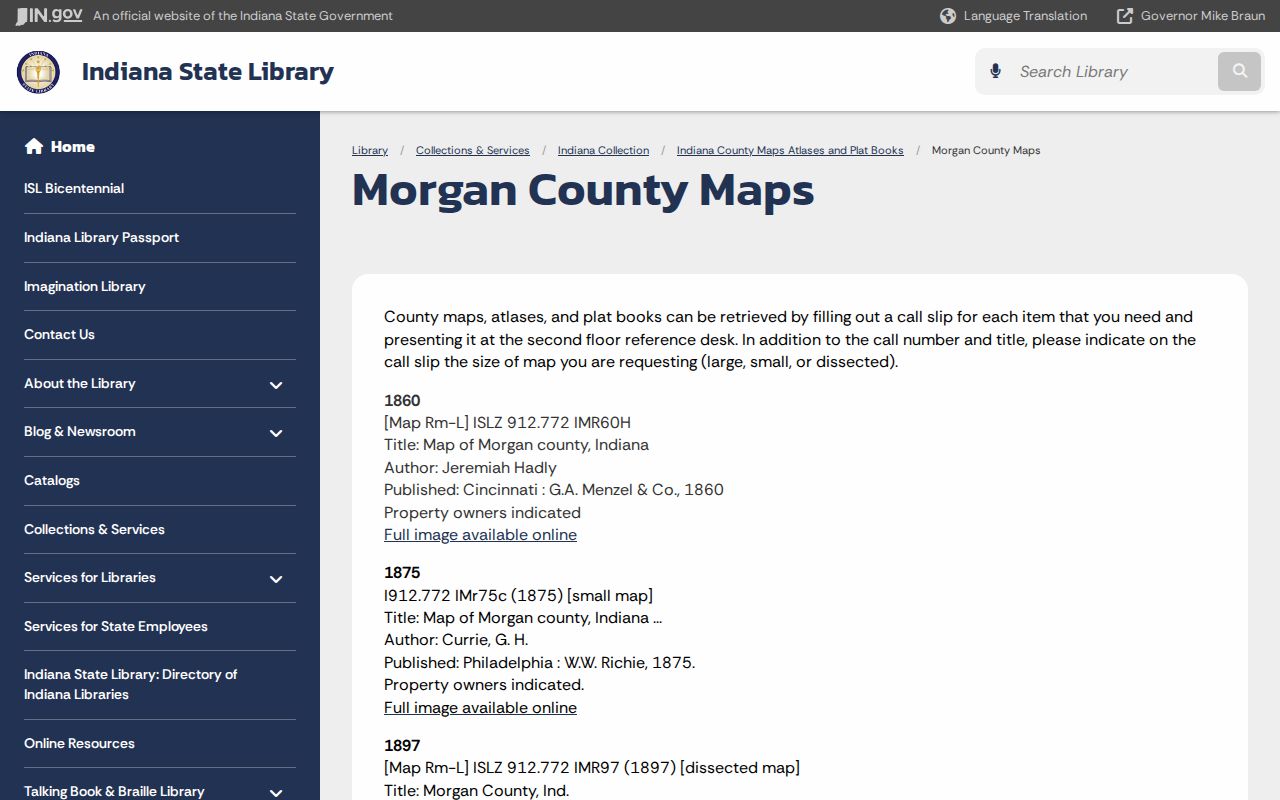
The dated map list helps you choose an edition close to the transfer period before searching the deed index. Record the map year and edition. An atlas may show ownership that predates publication, and a directory identifies occupancy rather than legal title.
How Far Morgan County Ownership Records Reach
Morgan County's local deed record reaches back to 1822. Older transfers may require a federal or state land entry. That identifies the original tract patent. The method shifts with each medium. A current parcel result gives way to the Doxpop index. Then comes the Recorder counter or microfilm, then the deed book, then tract and patent sources. Preserve citations at every step so another reader can reproduce the sequence of property records.
Online cutoff. Morgan's Doxpop coverage begins in January 1990. Former owners before that date must be followed through Recorder books, indexes, or State Library microfilm, and every result should be verified with the official custodian.