
Fields Inside Morgan County Property Tax Records
A Morgan County tax card tells two stories. One is value. The other turns value into a bill. The county's sample card separates land and improvement value, gross assessment, deductions, taxable assessment, the local rate, and normal tax. That order matters, because a deduction can lower taxable value without touching the assessor's gross estimate of market value-in-use.
| Record field | Meaning in the account | Official source |
|---|---|---|
| Land and improvements | Components used to reach gross assessed value | Morgan County Assessor |
| Gross assessment | Value before deductions and tax-cap effects | Assessor record |
| Taxable assessment | Amount remaining after applicable deductions | Treasurer tax card |
| Rate and normal tax | District rate and calculated property tax | Treasurer tax card |
| Installments and status | Amounts due, payments, or delinquency | Treasurer Tax List |
The card is not an appraisal. It may not state the last sale price either. For a plain-language walkthrough of the value terms, see the Morgan County property value guide.
Search the Morgan County Treasurer Tax List
The Morgan County Treasurer Tax List goes straight to the bill, holding 45,080 records and returning results 100 at a time. It supports three practical search modes.
| Search field | Input | Best use |
|---|---|---|
| Property Number | Whole or partial parcel number | Known parcel account |
| Name | Owner or taxpayer name | Split or combined parcel follow-up |
| Property Address | Number, street, and city | Known situs address |
Old parcel numbers sometimes retire. When a parcel was split or combined in the prior two years, the county advises trying the owner's last name instead. That hint often recovers the account.
Note: Keep the selected tax year with every amount because the same parcel can display different values and deductions across years.
Build a Morgan County Tax Bill Check
Work from identity to calculation to collection. A careful property tax lookup never treats one amount as the whole record.
- Search the county Tax List by property number, name, or property address.
- Open the matching account and verify the parcel, legal description, and tax year.
- Read gross value, deductions, taxable value, rate, and normal tax in sequence.
- Review installments, payments, delinquency, and any notice tied to the account.
- Compare the assessment fields with the DLGF Assessment Information search when a second source is useful.
- Assessed value
- Indiana's value for tax administration, based on market value-in-use.
- Taxable value
- The assessment after applicable deductions.
- Levy or rate
- The local tax calculation applied to the taxable base.
- Tax lien
- A public claim associated with unpaid property tax.
Morgan County's Sample Tax Card in Context
An inspected 2025 payable-2026 account for Goat Hollow Estates Lot 6 shows why the sequence matters. The card lists a $169,600 gross assessment and a $159,424 taxable assessment, followed by the rate and $2,152.54 in normal taxes. It also identifies the deeded owner as of January 1, 2025, a Martinsville situs, a Greenwood mailing address, Clay Township, and the Martinsville school corporation.
Those fields can confirm that the correct account was opened, but the card did not display a sale price, recorder instrument number, deed image, or book and page. Missing deed facts belong with the Recorder, not in an inference drawn from the tax amount.
Gross and Taxable Value in Morgan County
Indiana assesses real property at 100% of market value-in-use. The three value figures still differ. Gross assessment, taxable assessment, and likely sale price are simply not interchangeable, and the DLGF assessment overview explains the annual trending and ratio terminology behind them. Deductions and tax caps also shape the route from gross value to the final tax due.
Keep the numbers separate. A Morgan County assessment supports tax administration. It is not a private appraisal or a prediction of the property's sale price.
A recent sale can inform trending and review. It does not become the next roll value automatically. The assessment date, parcel characteristics, neighborhood model, and current cycle all shape the county record.
Deductions Recorded Against Morgan County Tax
Deduction programs differ. Homestead, over-65, veterans, and heritage barn options each carry their own eligibility and filing rules, and the DLGF exemptions and deductions guidance covers the full state list. The state generally sets an April 1 filing deadline. The proper form goes to the local administering office. Older bills read differently. Indiana repealed the mortgage deduction beginning with 2023 Pay 2024 bills. The homestead deduction also changed for bills issued in 2024, so copying a deduction line from an old Morgan County bill into a current estimate invites a false comparison.
Note: A deduction changes taxable value or tax treatment; it does not necessarily revise the assessor's gross value for the parcel.
The 2026 Morgan County Reassessment Turn
Morgan County's next reassessment turn is already scheduled. The statewide cyclical reassessment schedule opens a new cycle on July 1, 2026, for taxes payable in 2027. Each year reviews roughly one-fourth of all parcels. The county also makes annual adjustments from sales data. Inspection and trending are related but distinct changes. For 2025 field work, the Morgan County Assessor covered Adams, Ashland, Gregg, and Monroe townships plus the Town of Monrovia. That work can draw on exterior inspection, aerial photography, online listings, and building permits. Owners should compare the review year and property characteristics rather than assume every county parcel changed at once.
Contest a Morgan County Property Assessment
An appeal starts with the Form 11 notice. The mailing date controls the first deadline. From there, the DLGF property-tax appeal guide routes an owner to Form 130, an informal conference with the local assessing official, and then the Property Tax Assessment Board of Appeals. A case can continue to the Indiana Board of Tax Review. Some disputes even reach the Indiana Tax Court.
Protect the filing date. File Form 130 within 45 days after the Form 11 notice is mailed, or by May 10 when no Form 11 was issued.
Good evidence targets an objective flaw. Think an incorrect improvement, acreage, land classification, condition, or comparable evidence. The official DLGF forms library supplies Form 130 and related state forms, and the official Indiana property-tax appeals page lays out the local appeal route.
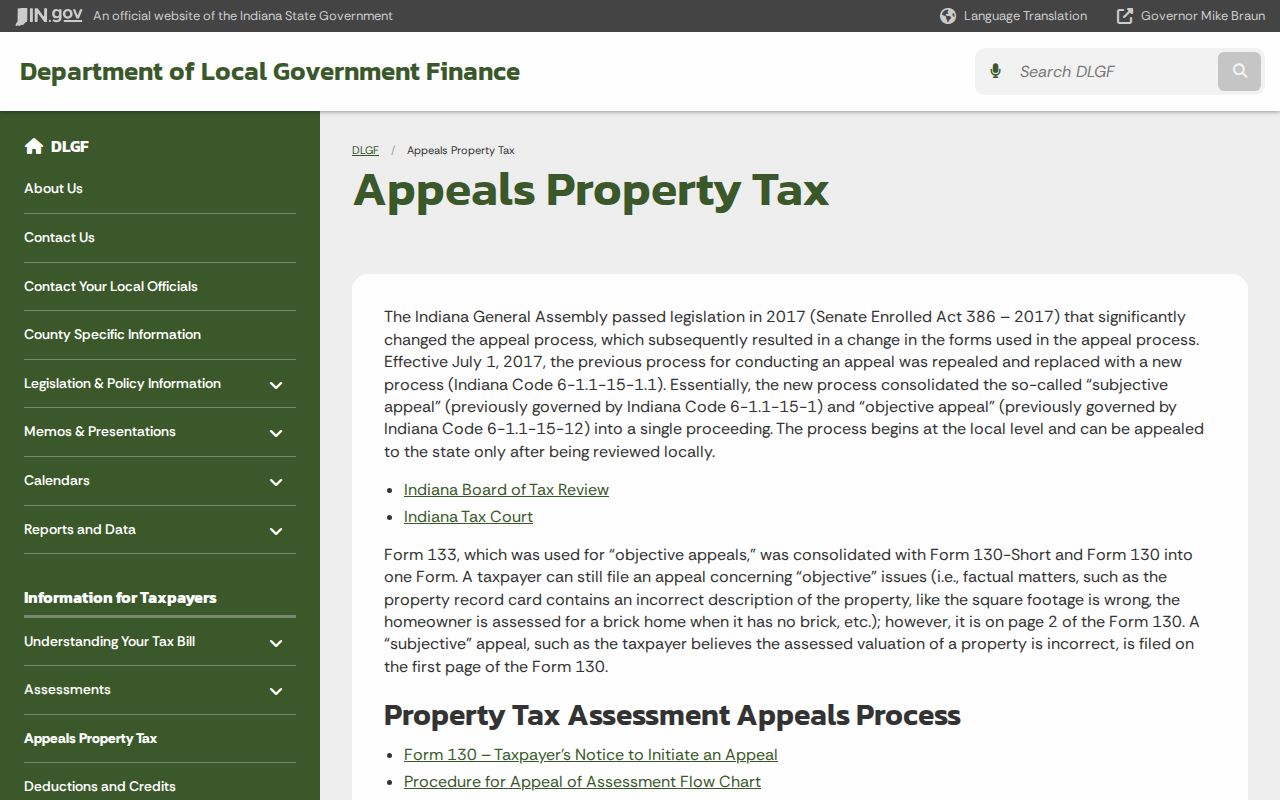
The state page reinforces the full sequence, from local review and PTABOA through later state review. The mailing date still sets the first deadline.
Delinquency and Morgan County Tax-Sale Records
A delinquent tax bill is not the same as a finished tax sale. Start with the current treasurer account. A parcel may enter the sale process later. At that point, Morgan County issues a separate notice covering registration, redemption, and sale procedure.
The 2024 notice laid out SRI Services registration, business-entity paperwork, redemption rules, and county-struck dates. It also adopted a streamlined approach: one newspaper notice followed by web notice. Those specifics change every year. So pull the current document through the county document browse before relying on any older version.
Counter, Phone, and Public-Records Routes
Portals can only answer so much. For delinquent tax bills and payment questions, visit the Morgan County Treasurer at 180 S Main St., Suite 129, in Martinsville, or call (765) 342-1048. Assessment issues belong with the Morgan County Assessor, Suite 218, at (765) 342-1065. Both offices keep weekday hours from 8:00 a.m. to 4:00 p.m.
When a formal request is needed, Indiana's Access to Public Records Act, IC 5-14-3, backs it up. Name the office, the record series, the parcel, the year range, and the format you want. Inspection itself carries no general access fee, though lawful copy charges may apply.
Note: August 2026 county building notices affected counter access, so confirm current arrangements before relying on the published courthouse address and hours.